Browser Games of Yesteryear
This is a companion post to the talk I gave at ElixirConf EU 2024 and sums up part of the research I did about browser games.
Computing & Games, circa 2000
In the early 2000s, computers were noisy boxes with huge CRT monitors attached to them. People would go to internet cafés or libraries to get access to a computer, and virtually all the time that wasn’t spend editing documents or managing email was spent on the web browser interacting with various websites. Back then, people were not allowed to install software such as games on public computers, so games that were distributed via Web Browsers instead of CDs were widely accessible. Many teenagers, myself included, ended up spending lots of time on websites like Miniclip, which at the time hosted hundreds of games. The most immersive titles were games similar to what you’d install locally, built with Adobe Flash, but Flash was an addon you had to install on your browser and thus out of reach on public computers. This left a gap for simpler simulation type games that could be played without visual elements other than simple images.
Multiplayer Browser Games
At this point in time, multiplayer browser games were somewhat of a novelty, and a popular one at that.
They could be played from school libraries, office computers,
and you were always a Ctrl + Tab away from what you were supposed to be doing. 😁
Often these games would give advantages to people that played the most amount of hours, which led some people to be playing all the time.
Some of these games were more artsy and fun, like Neopets, while others were fiercely competitive. All of them shared a strong network effect: there were referal bonuses for bringing in new players, and most would start with help from a friend.1
Experiment
If you enjoy games and game history, see if you can find someone to talk to about these games and what made them unique, and why almost all of them are terrible games today:
Neopets, Earth 2025, OGame, Travian, Ikariam, Gladiatus, Tribal Wars, Farmville, Mafia Wars.
In my talk I go over multiple games of this genre, identifying what makes them similar and a few of the features that make them unique. This is great if you’re going for a nostalgia effect since most people my age have heard and played most of these titles, but in practice you don’t get to explore any game fully. So in this post we’re going to be taking an in-depth look at one of these games.
OGame
Having spent hundreds of hours playing OGame, I feel particularly qualified to dissect this game. The idea is simple: you are in charge of a space empire and you manage economy, dictate diplomacy and wage warfare alongside or against other players.
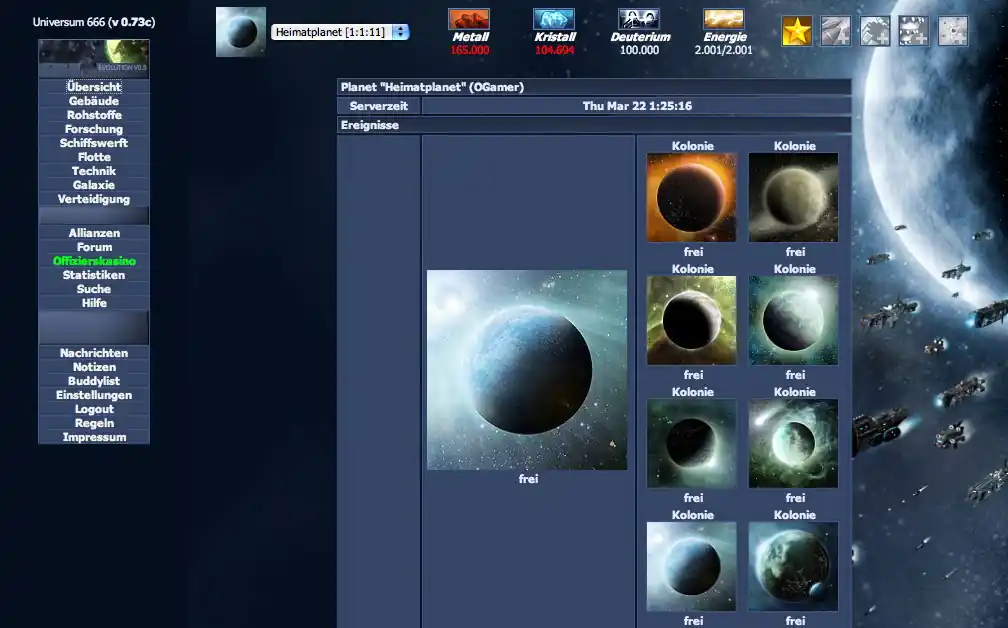
The game doesn’t stop when logging out: planets keep producing resources and other players can and will raid your planets for resources and to destroy your fleet. Staying logged in helps prevent raids on your own planets, allowing you to also spy on other planets, seeing which were inactive and farming them for resources.
In large servers, especially in the first few days, it was common to log in and see that you had been scanned dozens of times, and if you didn’t build enough defenses, odds are that you also had been attacked plenty of times too.
The meta had two main profiles of players:
-
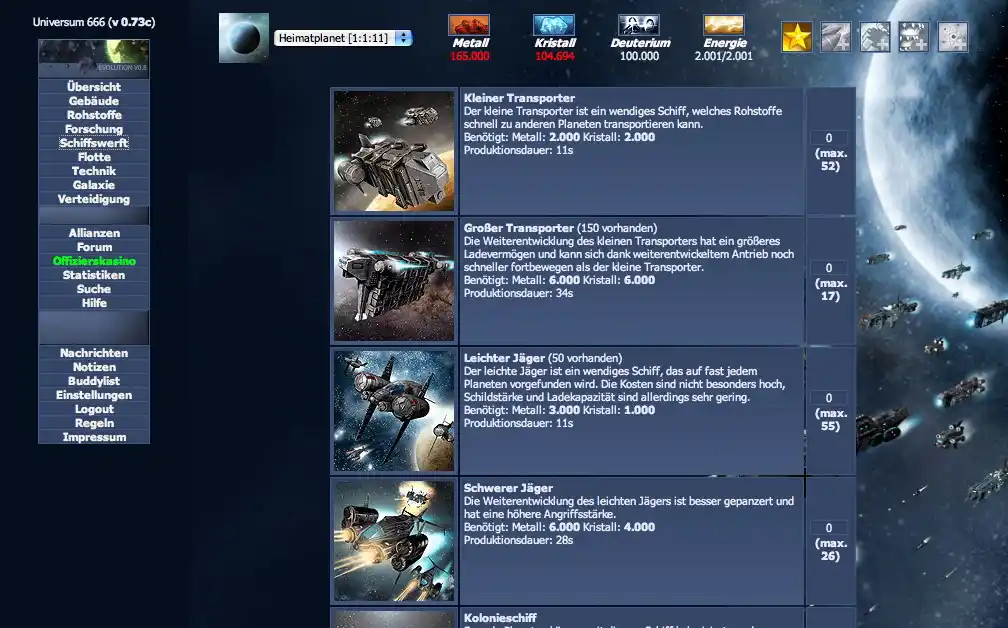
The always online type of player, whose playstyle would be to pump out ships as fast as possible and hunt down other player’s fleet and resources, called a fleeter.
-
The spreadsheet based miner, which focused on resource mining and building defenses to fend off raids. This type of playstyle required much less time online compared to fleeter, but had little to no warfaring capabilities.
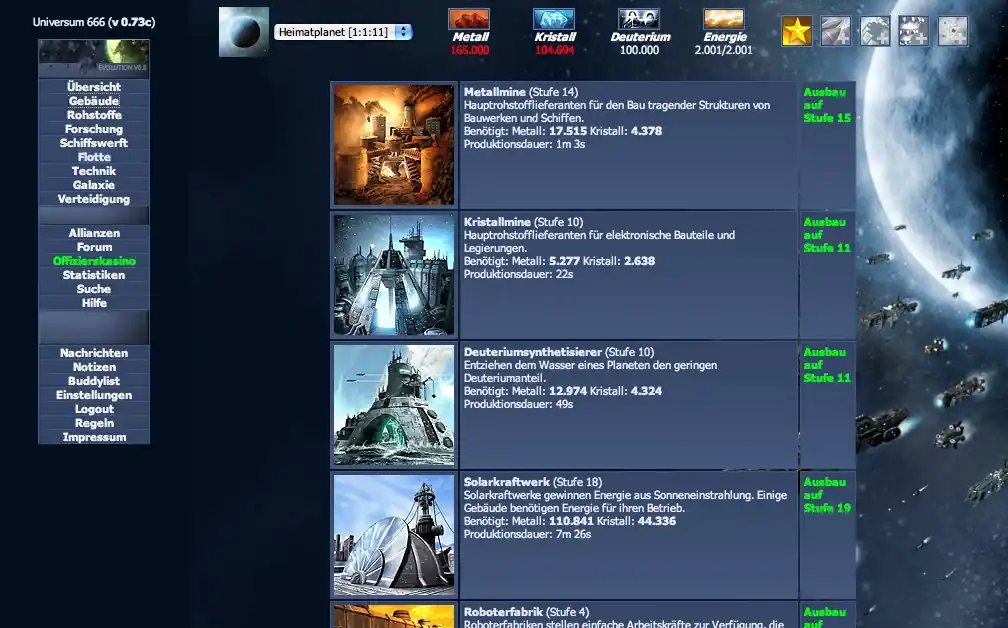
I was only able to find screenshots of how the game looked 20 years ago in German, which is where the game originated.
Scoring was based on how many resources you spent: you get 1 point for every 1000 resources you spend. Fleeters were known to rise quickly seeing as they stole resources from other players, but also fell quickly when they were hunted by a larger force. This is because when someone attacked you and you lost ships, you’d also lose the points you spent on those ships. Miners on the other hand rose slower in ranks, but due to focusing on economy and having almost no points that could be lost, they ended up topping the ranks in later stages of the game.
I’ll skip talking about many of the strategies people used to save their game state while they were offline since it’s too specific for this post, but feel free to look up fleetsaving for a glimpse of what that entailed.
Game Mechanics
OGame is primarily a Sci-Fi 4X game with some interesting game mechanics:
- Exploration & Area Control: colonizing solar systems was limited to just over a dozen planets. Additionally, wherever you colonized you projected military power, so miners looked to colonize away from fleeters so they could be safe from raids.
- Economy & Trade: the whole point of playing as a miner was to level up mines, produce more resources and spend it on more mines. Fleeters were constantly on the offensive, never having enough fuel to keep the war machine going. They would trade in some of their profits for fuel from miners, who produced much more than they needed.
- Research & Technology: buildings, ships and researches were progressively unlocked as players developed their empire. The tech tree was balanced and had late stage goals that both miners and fleeters were interested in.
- Combat & Fleet Management: ships of different types specialize in targetting other types of ships or defenses, so combat required a fleet composition that was appropriate for each battle. Often players managed different groups of ships so they could attack different players simultaneously.
Social Aspect
Players communities consisted of small in-game alliances of players, with global bulletin boards for player interaction. Discourse was civil… most of the time.2
During the golden age of OGame, it was not uncommon for alliances to meet up once or twice per year and have a dinner party. Sometimes people took flights or long drives to attend these dinner parties, just to hang out in person with the people they spent so much time in-game with.
Fleeters could send attacking fleets slower than usual in order to save fuel, which gave people the chance of asking for help without the attacker knowing. Friends could send what little ships they had available in a defensive holding pattern onto your planet, in order to destroy the profits of the attacker, and sometimes even wipe them out. Being able to pull moves like this provided memories that would last for decades.3
After large attacks, you could take the in-game combat report and publish it in the global discussion forum. These posts would be ranked by amount of destruction and profit, effectively creating a crude hall of fame of the biggest attacks on record. This was so common that there were specialty websites you could go to to paste in the in-game combat report and get back beautifully formatted BBCode, ready to paste into the forum.
Monetization
Almost all multiplayer browser games had a freemium model where everyone could play for free and there would be some features that would only be available if you paid for them. Some were mere conveniences, while others were paid bonuses that would give you an edge over non-paying players.
Most of the paid content I saw accross all games was subscription based, i.e. players paid a certain amount for access to premium features during 1-3 months. There were no microtransactions, or none that I could see.
If you played the game, you know that section shown in the top right corner of the old screenshots shows the paid add-ons. There were five main add-ons: extra energy production, resource production, fleet movement slots, faster research and the Commander, which is worth going over.
The Commander was the most convenient, least “pay to win” add-on, and buying it would get you:
- Building and research queues: the standard way of playing the game did not have queues; you’d build one building or research at a time. The building queue was a godsend when colonizing new planets or starting out on a new server, since the first levels of buildings and researches are quick to complete but you had to go through 30-40 levels.
- 1-click shortcuts: this will sound insane to anyone playing modern games, but yes, the game publisher came up with good UX and then removed it for free players.
- Ad-free experience: At some point banner type ads were shown in-game, which were removed if you had the Commander bonus active. In later stages they did away with Adsense in exchange for doing ads to other games of the same publisher, although these you weren’t removable even with Commander turned on 🙂
The game had multiple repetitive actions and the Commander was a way of making them a bit more tolerable. The other add-ons were pay to win advantages that only few players ever bought, not because it was a novelty to pay for in-game items, but because people often played multiple browser games at the same time, sometimes even playing the same game on different servers for fun.
Not all sunshine and roses
OGame was incredibly chaotic and addicting in the first few weeks after a server opened. Over time people built incredible fleets and fortresses of defenses that took weeks or months to build. Inevitably, both miners and fleeters eventually gave up playing:
- Fleeters would amass gigantic fleets by pumping out ships continuously for months. Battles between fleeters were common, and when a fleeter would get their forces completly wiped, they would often quit.4 It was devastating to lose progress that took months to build, and while the thrill of the hunt kept some from quitting, it would be hard to catch up with other players for the top ranks. Miners had a cap of 9 planets to manage, and mine costs were exponential while resource production was linear. This meant that in later stages, in order to upgrade mines, players would have to save up for weeks for a single mine upgrade, which in most cases was not a worthwile goal if they were not in the race for the top 100 players. This is because the always online nature of the game required daily logins to protect produced resources and dozens of other small account management actions, all for an ever increasing difficulty to progress.
Server churn
The game was a continuous simulation that started when the server opened and kept going indefinitely. For new players, this meant that they could never catch up with the top players if they joined a month or two after the server opened.
To give people a chance to reach the top, the publisher would open new servers at regular intervals. Servers would get really crowded on opening day and for the first few weeks and then eventually fade out of popularity. This, in conjunction with the fact that people quit on later stages of the game meant that servers went through a churn of players and would eventually become kind of empty - fleeters would have almost no one to hunt and miners would secure point advantages that were next to impossible to close.
Eventually the publisher learned how to monetize this sudden inflow of new players and came up with the concept of server mergers to join servers together if they were too empty. If you’re interested about this, I’ll write about that topic in a future post.
Nothing to play for
As personal computers became common and casual people stopped playing the OGame for more compelling games, many groups of friends were reduced to a single player after the fad fizzed down. Without a network of friends to play, the game just isn’t as enticing to play because there’s no more conversations about it. There’s always a group of old breed, die hard fans of the game, but these players were often your enemies in-game, the social aspect didn’t have the same value as before.
Who would you brag to about being the number 1 player of a game nobody plays anymore?
Players also got fatigued from doing the same routine over and over for years. There were no achievements to be made, nothing to be explored in the server, and no new content for many years. I always wondered why many of these games, OGame included, did not have any PvE content.
Those that kept coming back did it for the nostalgia of the good memories they had shared, but the game was no longer the same. It was like going into an old house you know, which feels painfully familiar; you know every corner, shared special memories with people at that place, but it is now empty. It’s hard to give it up because there’s sentimental value in the moments you remember, so it leaves you in this state of not being able to let go - it’s almost as if letting go means letting go of the memories, which is too painful.
Bad habits
Finally, the distinctive fact that it was an always running simulation made it intrude on your personal life. You had to be on to manage your empire, to prevent getting raided and so on. Having to open a game or losing progress makes opening the game somewhat of a chore. Worse of all, it rewarded terrible habits of people playing while working or playing instead of being with family. I won’t stress my opinion much more on this topic, but gaming should be something you clear time for while juggling other responsibilities. When gaming becomes a responsibility (if it’s not a job), it’s time to quit.
Is OGame still relevant?
The short answer is no, thanks to the lack of proper management, which I think makes for an interesting case study. The publisher of the game:
- Did not release new content to players for many years and did next to nothing to prevent the game from dying down.
- At the dawn of the mobile game era famously ignored player feedback to make the game mobile friendly and kept their layout desktop-only.
- Did not address any of the factors that made players churn, so the game lost player count continuously until now: a new server had upwards of 15.000 players from day one while today it is down to 400-500 on new servers.
To make matters worse, instead of trying to reverse the trend and bring back players who already knew the game, they instead monetized the game heavily in order to keep it running, something I’ll talk about in a future post.
What about other games?
OGame was one of the most successful games in this genre. Its publisher released 6 other very successful games which were very similar in mechanics: Tanoth, Gladiatus, Ikariam, KingsAge, BiteFight and BattleNight. Games from other publishers fared more or less the same, and some of them are still alive today, like OGame.
Clones
Reluctance to add convenience to players and refusing to give players faster economies in servers, “entrepreneurs” came forward with clones of the game that fixed some of its nuisances. Some were more successful than others and most focused on hyper growth economies for people to enjoy. Shockingly, as of the time of writing, one particular clone appears to have more players than the original game.
Successors
It may come as a surprise, but popular mobile games such as Clash of Clans or Rise of Kingdoms are spiritual successors to OGame’s genre. They systemically address all of the grievances of the game mechanics while providing a interactive graphical experience that browser games could never emulate.5
- Progress is kept: you always attack player’s towns and fight their defenses, it’s always armies versus town defenses, which means player’s armies are safe and don’t get wiped out. Players are issues protective shields if they are attacked too often in a given time interval. Town defenses are rebuildable and there are game bonuses to make up for part of the losses from being raided.
- Building queue: you’re allowed 2-3 workers per town, which you can use to have multiple upgrades going on at the same time.
- PvE Content: you learn to play the game with carefully designed single-player missions that teach you what each unit does and how to use it; this is infinitely better than figuring it out alone or having to ask a friend for help.
- Achievements & Challenges: there’s always something to do and something to strive for in a given week.
- Matchmaking: players that you attack and players that attack you are guaranteed to be of equivalent power, so you won’t have problems of top 10 players raiding someone much weaker.
- Global Server: no fragmentation of servers by country or region; everyone plays on the same server given the game’s async nature.
These successors have their faults too - they are monetized with predatory tactics to extract as much money as possible from willing players. There’s almost no ceiling to how much you can spend. Having said that, in almost every practical term, they are superior than the browser games of yesteryear.
Parting Thoughts
People that grew up with bad games will understand me when I say that even after all of these critiques of OGame, I still love this game. Nostalgia is a powerful emotion and it will make you grab on to things that maybe you should let go.
I believe you can only get to the stage of letting go once you apply some critical thinking. When it comes to nostalgia in games, it’s important to realize that:
- You are not the same person as the one in your memories playing that game
- The game is not the same, even if no changes were made - the environment, the context, the people that made up the game you remember are no longer in it.
- Nostalgia is a distraction from the present moment; wherever you are at right now, it’s unlikely that reminiscing or revisiting old habits will be healthy.
I think it’s fine to revisit old games, but it’s not so fine to take up old hobbies just for the nostalgia factor. This post ended up going in a different direction than I had originally planed, but I believe I needed to read this myself.
-
I remember the conversations I had with friends about what happened in-game, how it was almost all we’d talk about in the breaks between classes, and how I would enthusiastically talk about it with my parents when I got home. I talked so much about my favorite game that I eventually convinced my father and uncle to join me. ↩︎
-
People volunteered to moderate the forum and moderators were widely respected. It was thankless work of constantly formatting user posts to look clearer, moving them in between forum categories, censoring inappropriate content and banning users with a potty mouth. ↩︎
-
Despite not remembering who attacked me or the exact ship count, I remember very vividly the occasions where I, as a miner, was able to wipe out attacking fleets. This was something you could brag about indefinitely, and something I’ll probably remember for many more years. ↩︎
-
This was the first time I ever saw proof of the popular idiom of “there’s always bigger fish in the sea”. ↩︎
-
I know there have been advances with WebAssembly and that there are some graphical games that can be played successfully in the browser, but for now those seem quite niche. I may be wrong, but I feel the native experience on a mobile device will be hard to replace with a browser application, if not for anything else, than to have a clickable shortcut to play the game. ↩︎